STEAM Music Videos for K-12 Learning
An open educational media project that turns science and math concepts into accurate, readable songs and videos for classroom and at-home learning.
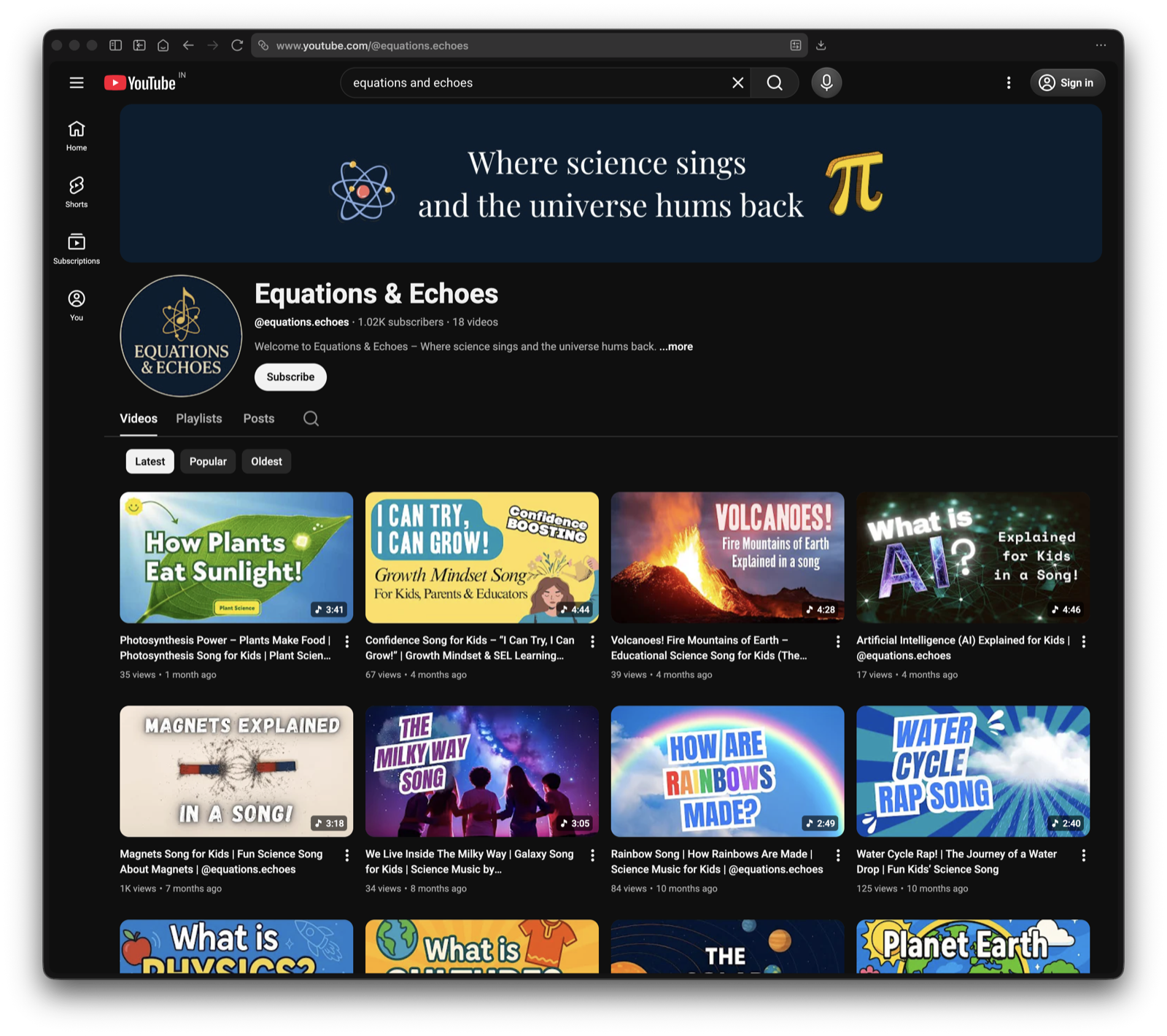
Screenshot of the Youtube channel: Equations & Echoes educational music videos channel.
Overview
Science and mathematics are often taught as though understanding were purely a matter of reading the right text at the right level. But comprehension is not only linguistic — it is also auditory, emotional, and aesthetic. Children learn songs before they learn equations. Rhythm and melody are among the earliest forms of structured knowledge that human beings acquire.
Equations & Echoes is built on that observation. The project uses AI-assisted production to create original music videos that explain STEAM concepts — from magnetism to cultural anthropology to statistical reasoning — through original songs, carefully sourced visuals, and narration calibrated for accessibility. The goal is not entertainment with a thin educational veneer, but genuinely accurate content that happens to be singable.
Visit the Equations & Echoes YouTube channel →Production Approach
Each video begins with a concept and a set of learning objectives. Song lyrics, narration scripts, and accompanying explanatory text are developed with AI assistance. All content is checked against Flesch-Kincaid readability scores to ensure it falls within the target reading level for the intended audience, and factual claims are verified before production.
Music is generated using AI-assisted composition tools, producing original songs in styles matched to the concept and tone of each episode. Visual material is sourced from Creative Commons and open-access repositories. The result is a fully open educational resource: freely viewable, freely shareable, and produced with a workflow that could, in principle, be replicated by educators with access to similar AI systems.
Open Educational Resource
Every video in the Equations & Echoes catalog is published as an open educational resource. No paywall. No institutional access requirement. The channel is freely available on YouTube, and all visual assets used in production are drawn from openly licensed sources.
This reflects a direct commitment: if the goal is equity in STEAM education, the outputs of the research cannot themselves be locked behind access barriers. The medium must be consistent with the message.
Accessibility Design
Accessibility is an explicit design criterion, not an afterthought. Scripts are written to target Flesch-Kincaid grade levels appropriate for middle school learners, ensuring that the content does not inadvertently require a college reading level to follow. Songs repeat key concepts at least three times in varied forms, applying spaced repetition principles to the musical format. Captions are included on all published videos.
The project also deliberately explores whether concepts that are typically presented as abstract and difficult — statistical confidence, electromagnetic fields, cultural epistemology — can be made genuinely memorable through musical encoding.
Current Status
Four episodes are published. Work is ongoing on additional episodes covering topics in biology, chemistry, and social science. The project continues to evolve both the production workflow and the pedagogical design criteria.