The Academy of Society & AI
An open education library for Society & AI
Artificial intelligence is already sorting classrooms, workplaces, and public life. It rarely asks first, and it almost never explains itself. The Academy is a free and open place to see how that works, and to make up your own mind about it.
We turn invisible systems into structures you can see, question, and challenge. Our goal is to help you understand quickly, explain plainly, and ask nothing of you but curiosity.
The Academy is Society & AI's teaching arm for minds shaping tomorrow.
Hover a node to learn more
A knowledge graph of the ideas behind the Academy
What the Academy offers
Play it, read it, teach it, talk about it.
Playing is one way to understand a system. Reading a plain explanation, running a lesson on it, and hearing from people it has already affected are others. The Academy is being built one piece at a time. Here is what you can use today, and what is on the way.
Mini Games
Word games and puzzles that make one idea concrete in about five minutes.
Play the gamesExplainers
Short, plain-language reads that define one term properly and show where you already meet it.
In writingClassroom Kits
Discussion prompts, printable activities, and a plan a teacher can pick up and run tomorrow.
In designFamily Activities
Screen-free things to do with a child, for homes where a spare device is not a given.
PlannedCommunity Voices
First-hand accounts of automated decisions, from students, teachers, and families.
PlannedMini Games
Mini Games about how the world is being sorted.
Word games and puzzles built around the ideas that decide things. How systems classify people, what a threshold really is, who gets to appeal. Each takes about five minutes.
Every game draws from a bank of hand-written puzzles and rotates through it, so opening the same game twice does not hand you the same problem. Each round closes with a short note on what the puzzle was actually about.
 Word game
Ages 12+
Word game
Ages 12+
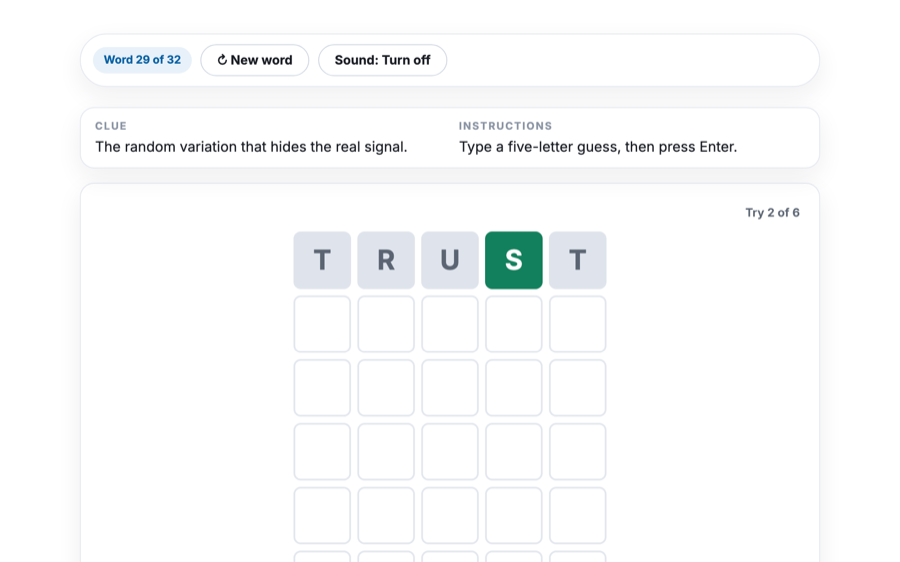
Concept Guess
A five-letter term, six attempts, and a clue that never leaves the screen. Solve it and find out why the word matters.
- Core vocabulary
- Labels & thresholds
- Civic language
 Word game
Ages 13+
Word game
Ages 13+
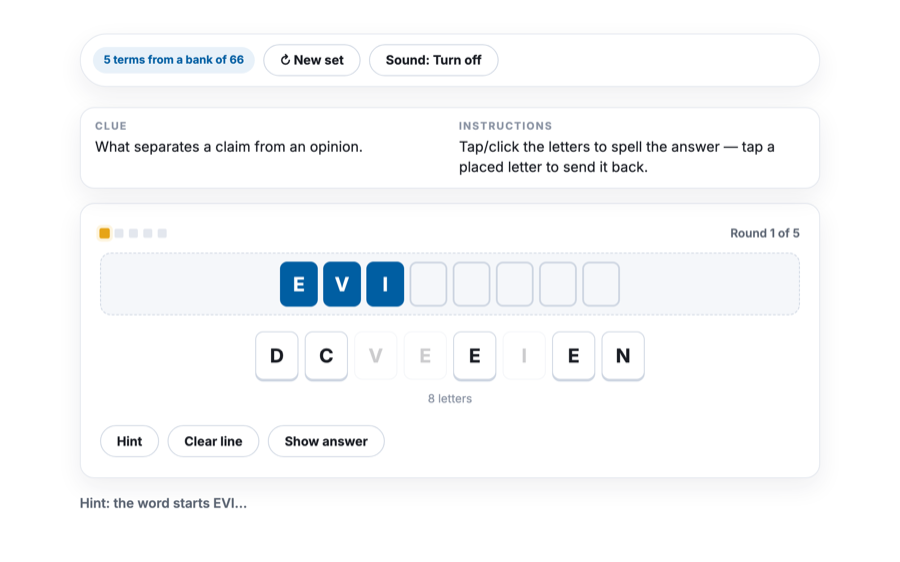
Word Untangle
Anagrams of the words that matter: consent, provenance, threshold, oversight. Rebuild each one from its scrambled letters.
- Consent & privacy
- Accountability
- Hidden labour
 Puzzle
Ages 13+
Puzzle
Ages 13+
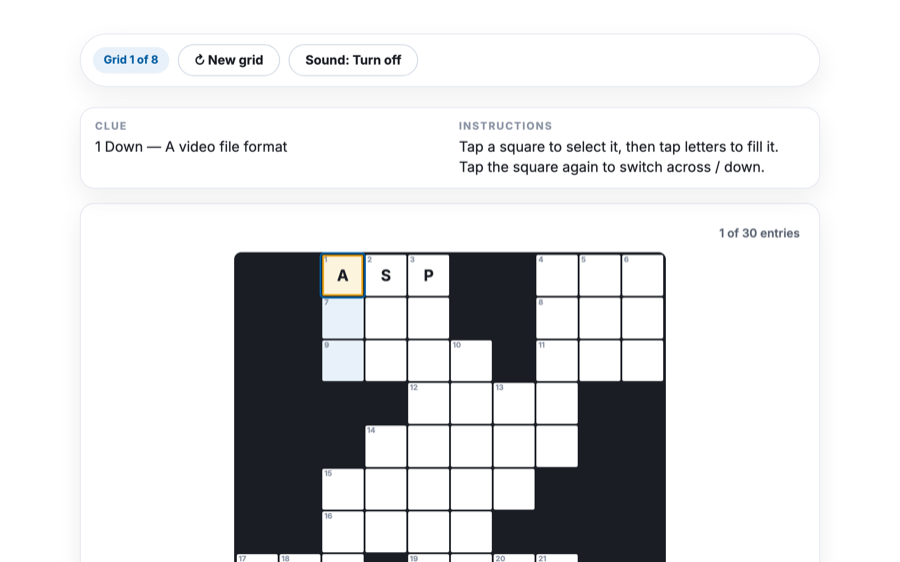
Mini Crossword
A randomized ten-by-ten grid built from the vocabulary of classrooms, media, and automated decisions. Every crossing is a constraint you can lean on.
- Cross-checking claims
- Classroom vocabulary
- Media & decisions
Ages 5–8
Where the youngest learners start.
Before a child can question a system, they need the idea that a system is even there. These two are wordless enough for a five-year-old: tap, drag, and watch a machine learn to sort and to guess. No reading level required, and no losing.
 Early learners
Ages 5–8
Early learners
Ages 5–8
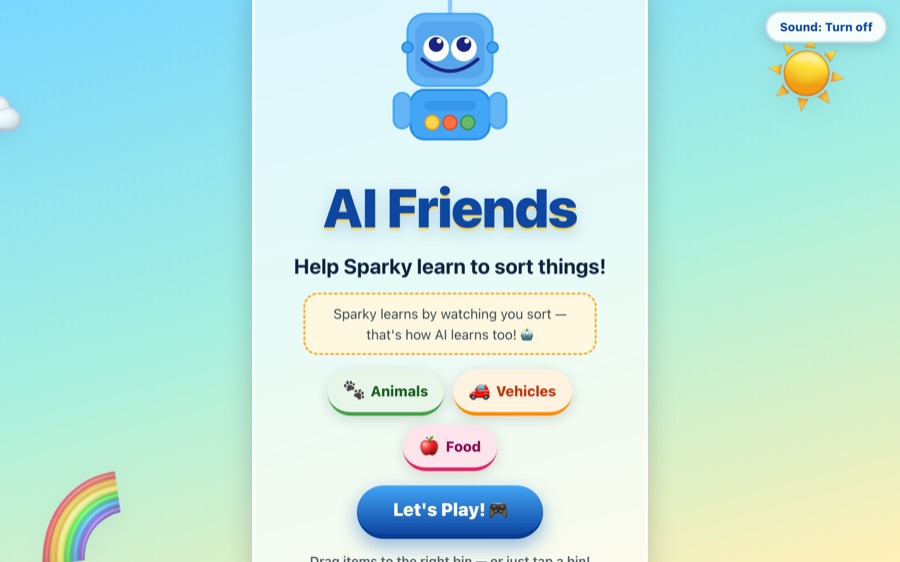
AI Friends
Help Sparky Sort!Sparky needs help sorting animals, vehicles, and food. Every choice shows how a machine learns to put things in boxes.
- Classification
- Labels & examples
- Sorting by feature
 Early learners
Ages 5–8
Early learners
Ages 5–8
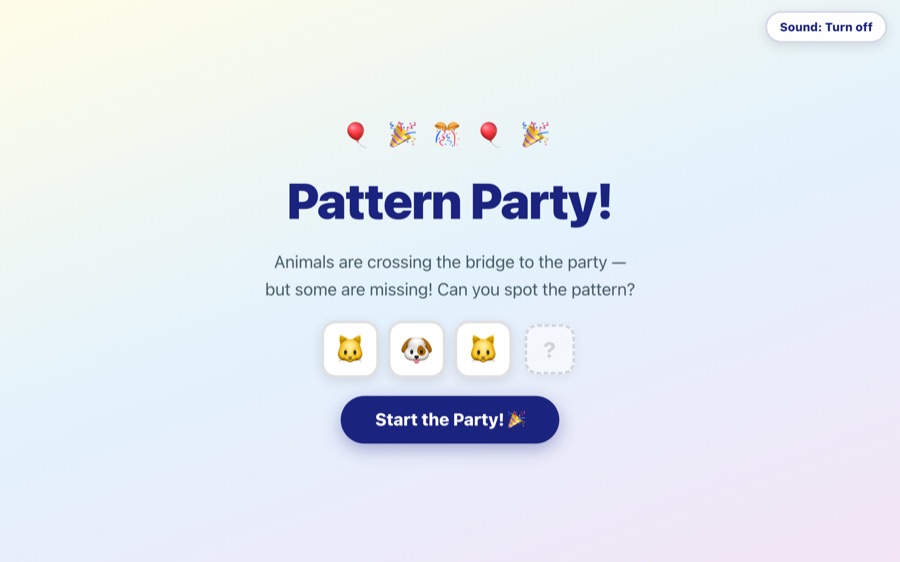
Pattern Party
Spot the Pattern!Finish the sequence and watch a machine guess what comes next. The first idea behind every prediction.
- Pattern recognition
- Prediction
- What stays the same
The case for the format
Why we start with games.
Because a game is the only medium that makes you do the thing rather than read about it. You cannot passively skim a puzzle. You have to commit to an answer, be wrong in a way nobody sees, and try again. That is how understanding actually arrives.
These are built for young learners first, and they work in a classroom, on a bus, or at a kitchen table. They are not arcade games with a lesson bolted on, and they are not finished: more games are on the way, for older students and adults as well as children.
Vocabulary is the bottleneck
You cannot argue about something you cannot name. Most people meet automated decisions long before they meet the words for them: proxy, threshold, disparate impact. A word game makes a term stick because you have to hold it in mind and manipulate it, not just read past it.
Close enough is not the same as right
Misinformation and disinformation are not synonyms. Equity is not equality. Matching a term to its exact definition against four plausible near-misses teaches a care that summaries never do.
Reflection beats reflexes
A puzzle has no clock and no penalty for a second attempt. That changes who can play: slower readers, cautious thinkers, and anyone for whom a timer means anxiety rather than excitement. Thinking longer is the winning strategy, and that is exactly the habit worth building.
The mechanic is the subject
An algorithm is an order of operations. A classifier is a set of boundaries. A crossword crossing is a constraint that checks another constraint. These mechanics are not a metaphor for the systems we study. They are the same structures, at a scale you can hold in your head.
Anyone can open one
Text and grids run on a decade-old phone, a school Chromebook, and a slow connection. Nothing to install, nothing to log into, no cost, no data collected. A game that demands a fast device has already excluded part of the class it claims to serve.
Short enough to talk about afterwards
Five minutes fits inside a lesson, a car journey, or a staff meeting. The value is rarely in the solving. It is in the argument that follows, which is why every game ends with a note rather than a score.
Where this is now, and where it goes next.
Today. 5 games are playable: 3 word games and puzzles for older students and adults, and 2 for ages five to eight. Each one rotates through a bank of hand-written puzzles, and those banks keep growing.
Next. Explainers and Classroom Kits are being written now. Family Activities and Community Voices follow after those. More games are on the way too, including a decision game where you set a threshold and live with who it lets through.
How it gets better. We watch how people actually play, then revise. If a puzzle is confusing, broken, too easy, or simply wrong about something, telling us is the fastest way to shape what gets built next.
- Always free
- No ads, no tracking
- No account needed
- Runs in any browser
Nothing here tests you, ranks you, or keeps a record. The only thing stored is a note in your own browser about which puzzles you have already seen, so the next one is different.
The Academy is designed, conceived, and developed by Sai Gattupalli, Ph.D., Principal Research Scientist of the Society & AI Research Group, as an exercise in scientific and social responsibility toward the communities this work is meant to serve.