A Closing Note on Open Education Week 2026 at Society & AI
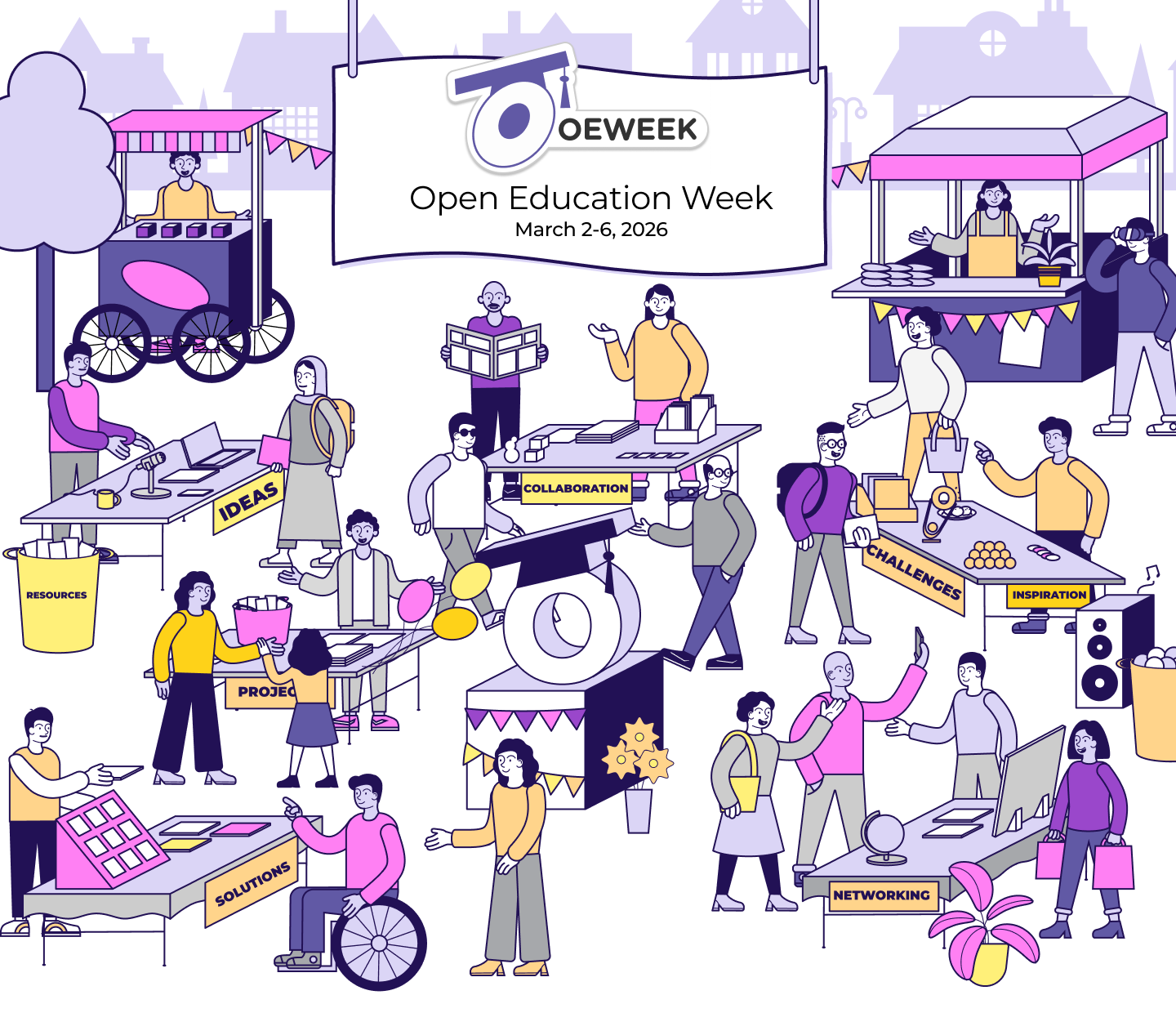
OEWeek artwork by Mario Badilla is licensed CC BY 4.0 / Open Education Global
Society & AI is proud to receive an Event Host badge from Open Education Global (Issued on: 21.4.2026).
Open Education Week is described by its organizers as “the global town square to gather, meet, celebrate, and exchange open education resources and practices.” For Society & AI, participating in that exchange was an invitation to put a question to the community: what are people actually thinking about artificial intelligence, education, and society — right now, from where they are standing?
We issued a special open call in early March and kept it open through March 31, 2026. We wanted to hear from educators, researchers, graduate students, practitioners, and independent thinkers — not just from institutions with publishing infrastructure, but from anyone paying close attention. We asked for the harder questions, not the success stories. We received eight submissions. Six were accepted, editorially reviewed, and published openly over the course of the month.
This is a brief reflection on what came through that call.
The Six Contributions
What arrived was more varied — and more considered — than a single theme could hold. Each of the following contributions was published as part of Open Education Week 2026 and carries this designation:
Part ofOpen Education Week 2026
The Case for Coherent, Whole-Program AI Literacy Integration by Elisa Sobo and Norah Shultz (San Diego State University, US) made a systems argument: that higher education's response to AI cannot be a patchwork of individual faculty choices, and that placing the burden of AI decision-making on individual instructors ultimately places students last.
Critical Thinking for Equity on Both Ends of the AI Model by Domi Smithson (Sheffield Hallam University, UK) examined what transparency and responsible practice require when black-box AI systems become routine in academic research — from the perspective of a Research Support Librarian and Open Research advocate.
Lecturer Development Requirements to Teach AI Literacy: Lessons from a European Student Survey by Tamara N. Lewis Arredondo (The Hague University of Applied Sciences, the Netherlands) drew on survey data from 360 students across four countries to argue that we are asking lecturers to teach AI literacy before we have prepared them to do so.
From Yes-Man to Wait-Man: What Changed When I Stopped Letting AI Talk Over My Thinking by Alex Luciano (Central Islip School District, US) offered a practitioner's account of what it actually takes to maintain professional judgment alongside AI — not in theory, but in a bilingual classroom carrying real cognitive load.
Beyond the Open-Weights: Open Education, the Global Compute Divide, and the Future of AI Literacy by Will Lee (University of Massachusetts Amherst, US) argued that openness stops at the wrong layer when it means releasing model weights without addressing the compute divide — the structural barrier keeping many schools and communities dependent on commercial AI systems they cannot inspect or govern.
AI Is Not the Root: A Reflection from Nature-Based Education by Alicia M. Highland (Tiny Green Learning, US) offered a reflection on what AI promises to fix in education — and what relational, place-based learning risks losing in the process.
What This Represented
These six pieces did not all agree with each other. They came from different disciplines, different institutional contexts, and different relationships to AI. That is precisely what we asked for.
Open Education Week exists, in part, to make visible the range of people doing serious work on open questions. What this call produced was a small demonstration of that range — six contributors, from three countries, across classroom practice, library science, instructional design, policy analysis, doctoral research, and community-based environmental education.
None of these contributors were obligated to write for us. Each one chose to trust Society & AI as a venue for work they cared about. We are genuinely grateful for that.
All six contributions remain freely accessible — no paywall, no login — at societyandai.org/oeweek2026.
About the Author
Sai Gattupalli, Ph.D. is the founder and Editorial Director of Society & AI, and a postdoctoral alumnus of the Advanced Learning Technologies Lab at the University of Massachusetts Amherst. His research examines how AI systems mediate learning, knowledge production, and educational access — with sustained attention to culturally responsive design, learning technologies, and the structural conditions under which learners in diverse and under-resourced settings can genuinely flourish. Society & AI is his independent scholarly commons — a platform designed to keep rigorous, society-centered scholarship on artificial intelligence and education freely accessible to educators, researchers, and communities worldwide, without paywalls or institutional gatekeeping.
Cite this article
Gattupalli, S. (2026). A closing note on Open Education Week 2026 at Society & AI. Society and AI. https://societyandai.org/editorial/oeweek2026-closing-note/
Write for Society & AI
Society & AI remains open for guest contributions year-round. We welcome perspectives from educators, researchers, policymakers, and practitioners at the intersection of artificial intelligence, education, and society. All work is published openly and free of charge. Send your proposal to submissions@societyandai.org.