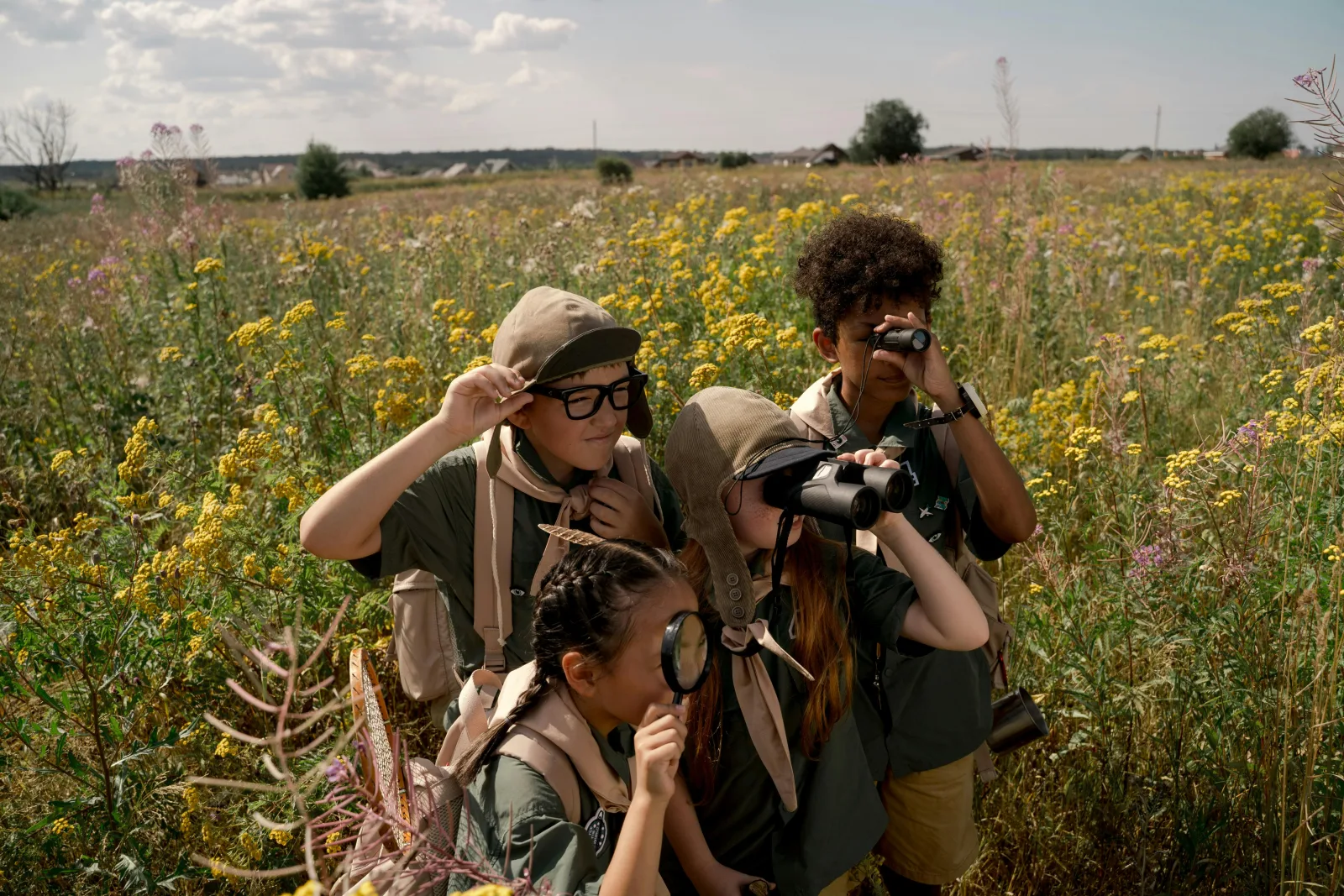

The photograph above depicts a group of young people gathered in an open meadow — the kind of unstructured, living landscape that has become increasingly rare in childhood experience. It stands as a quiet counterpoint to the dominant narrative of technological progress: a reminder that belonging to a place, moving through it, and learning within it are not peripheral to education, but central to it. In an era of accelerating screen time and algorithmic mediation, such moments of embodied presence in the natural world represent something fragile, and something worth protecting.
The integration of artificial intelligence into education has generated considerable enthusiasm — and, for many practitioners working in equity-oriented and place-based settings, considerable unease. This reflection sits with that unease honestly.
I run a small, nature-based education organization serving families who have historically been excluded from green spaces, environmental programming, and outdoor belonging. Much of our work centers relational learning — children exploring creeks, noticing seasonal change, sharing family plant stories, and building community in public parks.
Recently, in professional spaces, I have been told — gently but consistently — that we must integrate artificial intelligence into our educational practice. AI is described as a tool for efficiency, personalization, equity, and scale. The message is not hostile. It is framed as innovation. As opportunity.
But I find myself asking: what problem is AI solving? And for whom?
The inequities my organization confronts did not emerge from a lack of technological sophistication. They are rooted in long-standing structural conditions: chronic underfunding of BIPOC-led organizations, racialized distribution of green space, environmental health disparities, and public disinvestment in community-based education. These are not technical glitches. They are outcomes of policy, capital flows, and historical exclusion.
AI is often presented as a corrective to educational inequity — a democratizing force that can personalize learning, expand access, and reduce administrative burden. And in some ways, it can. I use digital tools in my own work. They can save time. They can assist with formatting and organization. They can extend capacity in under-resourced settings.
But tools built within unequal systems do not automatically dismantle those systems.
As writer Ruha Benjamin (2019) has argued, technologies designed within existing social structures tend to reproduce, and in some cases amplify, the inequities already embedded in those structures, regardless of the intentions behind their design.
The expansion of AI depends on centralized infrastructure: energy-intensive data centers, massive computational power, and concentrated corporate ownership. At the same time, the families my organization serves are navigating rising living costs, environmental health burdens, and economic precarity. I struggle with the dissonance between promises of technological equity and the material realities in communities already bearing disproportionate environmental and economic strain.
My work centers ecological literacy — helping children understand interdependence, limits, and the relationship between human activity and land. AI, by contrast, operates through abstraction and scale. It extracts patterns from vast datasets, removes knowledge from place, and optimizes for efficiency. Ecological education asks children to slow down, to notice, to situate knowledge in context.
These are not mutually exclusive forms of intelligence. But they are built on different assumptions.
In nature-based learning, knowledge is relational. A child learns about water quality by standing in a stream. They learn about seasonal change by returning to the same tree week after week. Learning unfolds through embodiment and repetition. It is slow. It is place-bound.
This is not a romantic idealization of outdoor experience. A growing body of research documents that sustained, direct engagement with natural environments produces measurable benefits for children’s learning, attention, and sense of belonging — effects that are difficult to replicate in abstracted or screen-mediated settings (such as Kuo et al., 2019; Louv, 2013). The case for protecting this kind of learning is not sentimental. It is empirical.
AI accelerates. It predicts. It generalizes.
Plugged and Unplugged: What Is Being Displaced
There is a useful distinction in education research between plugged and unplugged learning, between activities mediated by screens and devices, and those that are not. Unplugged learning encompasses everything that happens when children are in direct, unmediated contact with the world: building, observing, moving, gardening, listening, asking questions of a living environment rather than a digital one.
Nature-based education is, by its very design, unplugged. That is not an accident or a limitation. It is the point. The creek does not have a loading screen. The tree does not offer a personalized recommendation. The learning that unfolds in those encounters cannot be datafied, optimized, or scaled, and that is precisely what makes it irreplaceable.
As education systems accelerate toward AI integration, screen time expands and unstructured, embodied experience contracts. For young learners in particular, this displacement carries real developmental consequences. The time a child spends with a tablet is time not spent outside.
As AI becomes normalized in education, the pressure to adopt it intensifies. The language of adaptation is framed as empowerment: educators must innovate or risk irrelevance. Yet when adaptation becomes tied to professional survival — when “use these tools or fall behind” becomes the subtext — it begins to feel less like liberation and more like compliance.
I do not believe that individual educators are being coerced in an overt sense. But I do question the broader narrative: that technological acceleration is synonymous with progress, and that equity will follow from efficiency.
In my field, we have long known that equity requires redistribution — of resources, land access, funding, and decision-making power. It requires investment in community-rooted organizations. It requires attention to environmental justice. None of those structural shifts are guaranteed by the adoption of AI.
In fact, without deliberate governance and redistribution, emerging technologies often amplify existing power structures. Ownership concentrates. Infrastructure expands unevenly. Communities with fewer resources adapt under pressure, while those with capital shape the terms of innovation.
This is the tension I sit with as an educator. I am not opposed to AI categorically. I use digital tools strategically. But I resist the framing of AI as a cure-all for inequity in education — particularly when the inequities we face are historical and structural.
If we are serious about justice in education, we must ask harder questions than whether AI can personalize instruction or streamline workflows. We must ask who owns the infrastructure. Who benefits from its expansion. Who bears its environmental costs. And whether we are willing to invest as deeply in relational, place-based education as we are in artificial intelligence.
I have come to see AI not as the root ailment in education, but as a symptom of a broader societal pattern: a tendency to seek technological solutions to structural injustice without confronting the underlying distributions of power and resources.
Meanwhile, the children in our programs still need trees, open space, and time. They need adults who are present. They need opportunities to build belonging in landscapes that have not always felt accessible to their families. No algorithm can replace that.
Perhaps the question is not whether educators should use AI. Perhaps the question is whether we can hold two truths at once: that digital tools may offer efficiencies, and that justice requires more than optimization.
In a world accelerating toward artificial intelligence, ecological intelligence — grounded in interdependence, humility, and place — may be just as urgent.
References
Benjamin, R. (2019). Race after technology: Abolitionist tools for the new jim code. John Wiley & Sons.
Kuo, M., Barnes, M., & Jordan, C. (2019). Do experiences with nature promote learning? Converging evidence of a cause-and-effect relationship. Frontiers in Psychology, 10. https://doi.org/10.3389/fpsyg.2019.00305
Louv, R. (2013). Last Child in the Woods: Saving our Children from Nature-Deficit Disorder. Atlantic Books Ltd.
About the Author
Alicia M. Highland is the Founder and Executive Director of Tiny Green Learning, a 501(c)(3) nonprofit organization dedicated to connecting children, families, and communities to nature through place-based education. Based in Northeast Ohio and expanding to the Twin Cities, Tiny Green Learning has reached over 4,600 families online and served more than 450 participants through in-person programming. Her work centers relational, embodied, and community-rooted learning — designing educational experiences that honor local ecology, cultural knowledge, and the right to outdoor belonging. She holds a Master of Education in Teaching and Curriculum, with a concentration in Education for Environment and Community, and a Master of Arts in Elementary Education.
Correspondence: alicia.tinygreenlearning@gmail.com
Cite this article
Highland, A. M. (2026). AI is not the root: A reflection from nature-based education. Society and AI. https://societyandai.org/perspectives/ai-is-not-the-root/
Write for Society & AI
We welcome contributions from educators, researchers, policymakers, and practitioners examining the intersection of artificial intelligence, education, and society. All work published on Society & AI is made available free of cost and in open access, in service of education and the public good. If you have a perspective to share, send your proposal to the Editorial and Content Director at submissions@societyandai.org.