We Are Living in the Effects of a Cause We Never Authorized
On artificial intelligence, causal inversion, and the social consequences of decisions no one collectively made
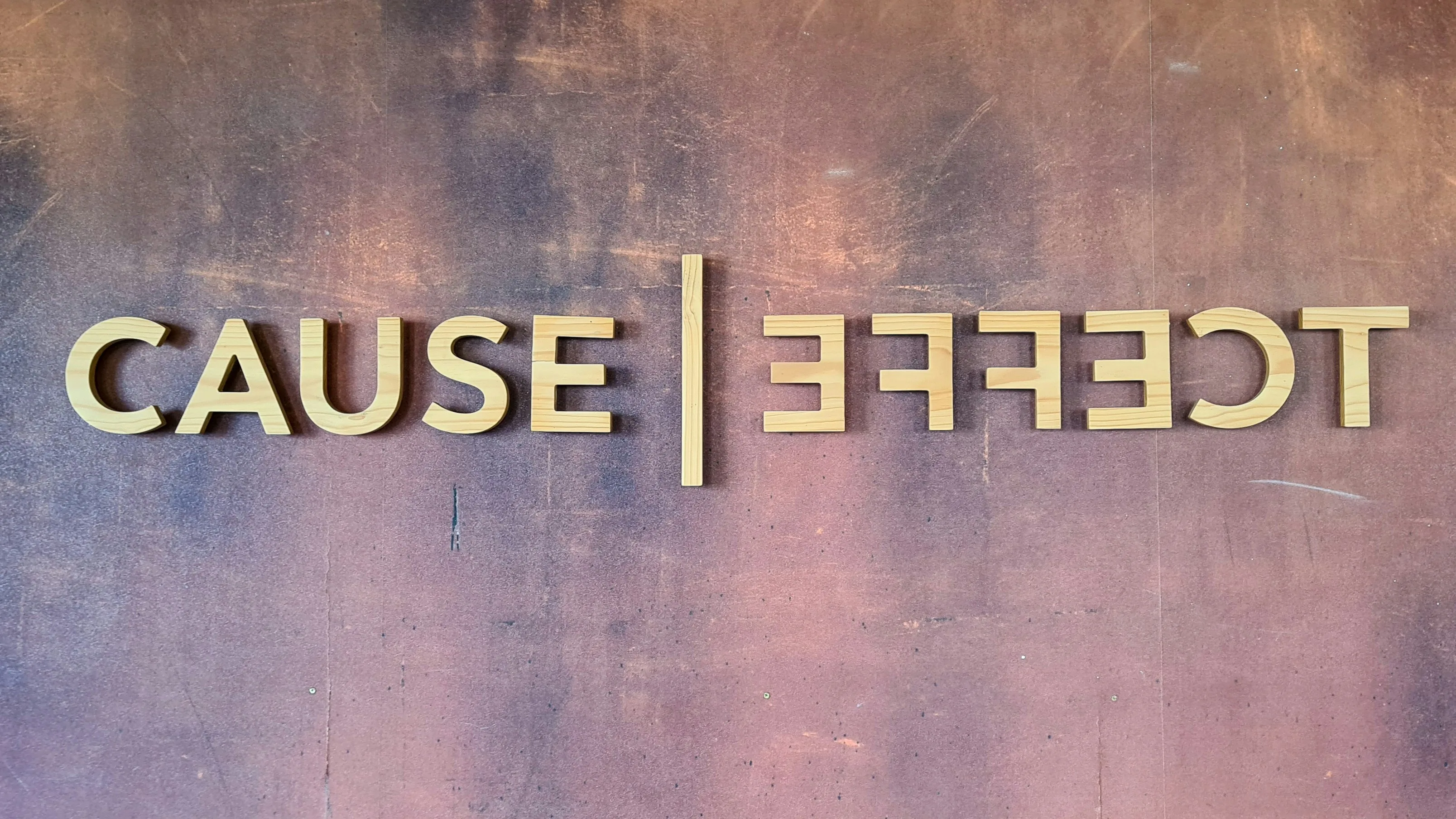
Image credits: Delano Ramdas/Unsplash
Physics gives us one of the clearest rules we know: causes precede effects. A pin touches a balloon, then it bursts. A signal is sent, then it is received. This is not etiquette; it is structure. Relativity formalized that structure by tying causation to spacetime itself. Cause first, effect after.
In social life, the same sequence should hold in institutional form: a society studies a change, debates it, authorizes it, and only then absorbs its consequences. But under contemporary AI deployment, that sequence is being inverted. The consequences are arriving first. Collective authorization, if it arrives at all, comes later.
Workers are displaced before policy has meaningfully adapted. Students are re-schooled by generative tools before long-horizon evidence has matured. Communities are asked to normalize outcomes they never consented to. This is not a violation of physical law. It is a violation of causal accountability.
This essay asks a simple question: what happens when social effects systematically outrun social causes? And what would it take to restore causal order in public life?
The Physics of Before and After
The claim that causes come before effects feels obvious, but philosophy and physics have worked hard to explain why.
Aristotle argued that events have efficient causes: active forces that bring outcomes into being. The sculptor’s hand moves, then the statue takes shape (Aristotle, c. 350 BCE). Kant later suggested that causal ordering is not just observed but constitutive of human cognition; we encounter experience through causal structure, rather than discovering causality only after repeated observation (Kant, 1781/1929).
The point I want to make here is analogical, not mathematical. Human societies have no built-in equivalent to those physical constraints. We have to construct causal order institutionally through evidence standards, democratic process, and enforceable accountability. Contemporary AI development shows the cost of failing to do so: work is reorganized before labor protections adapt, learning environments are transformed before longitudinal evidence matures, and governance is pushed into retrospective justification rather than prospective authorization.
The Social Light Cone
Major technologies have always been disruptive. But many still unfolded within a window where institutions could react.
The printing press transformed literacy and authority over generations. Industrialization displaced workers brutally, yet labor law, mass schooling, and welfare institutions eventually formed in response. The internet accelerated everything, but debates on privacy, competition, copyright, and platform responsibility still unfolded over two decades, not two product cycles.
Call that window a social light cone: the time between impact and institutional response. In that window, a society can observe, deliberate, and redesign rules before harms harden into structure.
AI is not just faster. Its effects are often arriving outside that social light cone. By the time institutions identify a harm, gather evidence, negotiate policy, and implement safeguards, another deployment cycle has shifted the baseline again. The loop between decision and accountability weakens, and with it, the credibility of governance itself.
Two Causal Inversions
This inversion appears across domains, but labor and learning are where it is already most visible.
1. The Labor Inversion
In a conventional transition, a rough sequence holds: technology arrives, adoption spreads, pressure on workers becomes visible, then adaptation institutions form, training pipelines, social insurance, and new occupational tracks.
AI has compressed that sequence dramatically.
At the World Economic Forum meeting in Davos on January 20, 2026, Anthropic CEO Dario Amodei projected that up to 50% of entry-level white-collar roles could disappear within five years (World Economic Forum, 2026). Demis Hassabis stated that Google DeepMind had already reduced junior hiring. These are not distant forecasts; they are deployment-side observations from leaders building and shipping these systems.
The trend is global. In March 2026, reporting on Oracle’s layoffs described 12,000 jobs cut in India within a broader global reduction tied to AI investment priorities (Hindustan Times, 2026). In the United States, employers announced 60,620 cuts in March 2026, with AI cited prominently in a substantial share of disclosures, including at large firms such as Meta, Atlassian, and Salesforce (Roeloffs, 2026). The World Economic Forum estimates 92 million jobs could be displaced by 2030 (World Economic Forum, 2025, p. 5).
The core issue is not that labor markets change. They always do. The issue is who decides and who absorbs the cost. Deployment decisions are concentrated among firms, investors, and executive leadership; consequences are distributed across workers and communities that had no voice in those decisions.
The people who made the deployment decisions are not the people bearing the consequences. That gap, between who decides and who suffers, is a failure of causal accountability at civilizational scale.
When causal actors and effect-bearers are structurally separated, ordinary accountability degrades. Responsibility becomes rhetorically diffuse even when decisions are strategically explicit.
2. The Learning Inversion
Cognitive science has long shown that durable learning depends on effortful retrieval, error correction, and what UCLA Psychology professors Elizabeth Ligon Bjork and Robert A. Bjork describe as desirable difficulties (Bjork and Bjork, 2011). Productive struggle is not pedagogical failure; it is often the mechanism of memory consolidation and conceptual transfer.
Unstructured reliance on AI tutors and writing assistants can remove that struggle at the exact point where learning should occur. A student can complete the assignment while bypassing the cognition the assignment was designed to activate. Sparrow, Liu, and Wegner (2011) found that when people expect instant external retrieval, they encode less internally. Outsourcing can become a cognitive habit before it is recognized as one.
This is now happening at system scale. Schools across multiple national contexts, including Kenya, South Korea, Brazil, and the United States, are integrating AI into learning workflows while long-horizon evidence on developmental effects remains limited.
We are restructuring how an entire generation learns before gathering the evidence that would, in any careful science, authorize us to do so.
Again, the sequence flips. Evidence should authorize transformation. Instead, transformation is generating the post hoc demand for evidence, after real students have already lived through the intervention.
A Reality That Is Not Going Away
To be clear, this is not an argument for halting AI progress, nor a claim that every application is harmful. The pattern is largely emergent: rapid technical capability, competitive pressure, and institutionally slow governance interacting at high speed.
But it is equally important to reject the comforting idea that this is a temporary wave. AI is being embedded into schools, workplaces, finance, healthcare, legal systems, and public administration as infrastructure. For many institutions, rollback is no longer a realistic default path.
That makes the question institutional, not emotional: can we build governance rhythms that reinsert deliberation before irreversible deployment effects?
Conclusion
Physics protects causal order automatically. Societies do not.
If we want coherence and legitimacy under AI conditions, we must construct causal safeguards deliberately: evidence that precedes mass adoption, labor policy that anticipates displacement, education policy that distinguishes convenience from learning, and governance processes that include those who bear the cost of technical decisions.
This is not anti-innovation. It is pro-accountability. A society that permits effects without authorized causes does not remain democratic for long.
References
Aristotle. (c. 350 BCE). Physics. Book II. https://archive.org/details/in.ernet.dli.2015.183610/page/2/mode/2up
Bjork, E. L., and Bjork, R. A. (2011). Making things hard on yourself, but in a good way: Creating desirable difficulties to enhance learning. In M. A. Gernsbacher and J. Pomerantz (Eds.), Psychology and the real world: Essays illustrating fundamental contributions to society (pp. 56–64). Worth Publishers.
Hindustan Times. (2026, March 30). Oracle layoffs: 12,000 employees in India among 30,000 laid off, more job cuts expected soon. https://www.hindustantimes.com/india-news/oracle-layoffs-12000-employees-in-india-among-30000-laid-off-more-job-cuts-expected-soon-101775024329595.html
Kant, I. (1781/1929). Critique of pure reason (N. Kemp Smith, Trans.). Macmillan. https://www.academia.edu/download/55012233/The_Critique_of_Pure_Reason.pdf
Roeloffs, M. W. (2026, April 2). AI blamed heavily for March layoffs, report says. Forbes. https://www.forbes.com/sites/maryroeloffs/2026/04/02/ai-blamed-heavily-for-march-job-cuts-report-says/
Sparrow, B., Liu, J., and Wegner, D. M. (2011). Google effects on memory: Cognitive consequences of having information at our fingertips. Science, 333(6043), 776–778. https://doi.org/10.1126/science.1207745
World Economic Forum. (2025). Future of jobs report 2025. https://reports.weforum.org/docs/WEF_Future_of_Jobs_Report_2025.pdf
World Economic Forum. (2026, January 20). The Day After AGI [Panel discussion]. World Economic Forum Annual Meeting. https://www.weforum.org/meetings/world-economic-forum-annual-meeting-2026/
About the Author
Sai Gattupalli, Ph.D. is an educational technology researcher and learning scientist focused on the design and evaluation of AI systems that advance educational equity and human flourishing. As Principal Scientist and Director of the Society & AI Research Group, he studies how AI reshapes knowledge creation, pedagogy, and access across diverse educational and cultural contexts. His work spans AI literacy, intelligent tutoring systems, and society-centered AI governance, with a sustained commitment to scholarship that is both rigorous and publicly actionable.
Cite this article
Gattupalli, S. (2026). We are living in the effects of a cause we never authorized. Society and AI. https://societyandai.org/perspectives/causal-inversion-ai-society/
Write for Society & AI
Society and AI is dedicated to exploring the profound convergence of artificial intelligence, education, and the broader social fabric. We welcome scholarly contributions that navigate this tripartite intersection, offering rigorous yet accessible insights into how intelligent systems are reconfiguring the way we learn, govern, and live together. Scholars, educators, policymakers, and practitioners are invited to submit proposals to the Editorial and Content Director at sai@societyandai.org.