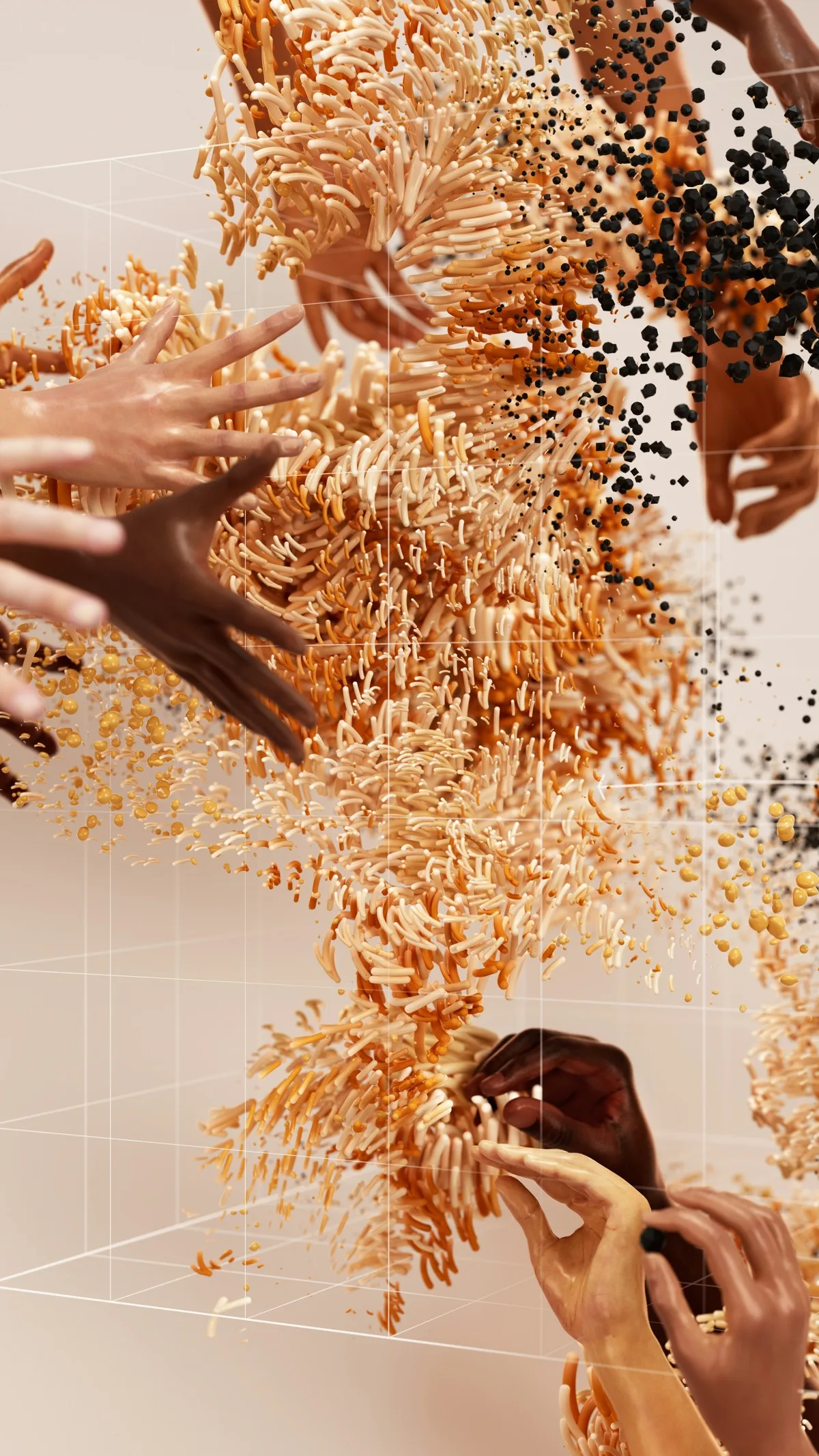

The image you see above—a human silhouette filled with living greenery—captures something essential about the relationship between individuals and the collective systems we inhabit. I chose this particular image because it visualizes a core insight: society is not external to us, something we merely observe or participate in from the outside. Rather, society grows through us, shapes us, and is shaped by us in turn. The human form provides the structure, but what fills that structure—the vibrant, organic network of relationships, norms, and shared meanings—is what gives society its life and resilience.
This visual metaphor matters because as we examine artificial intelligence’s integration into educational systems and social institutions, we must first establish clarity about what “society” actually is. Without this foundational understanding, our discussions of AI governance, educational equity, and technological transformation lack essential grounding. So let me offer a definition that is both precise and usable—one that allows us to evaluate tools, including AI, by their contribution to human flourishing and democratic accountability.
Defining Society: More Than the Sum of Individuals
Society is the enduring pattern through which people organize their collective life. It comprises relationships among individuals and groups; the institutions that channel and constrain behavior; the cultural meanings that guide judgment; and the material systems—land, infrastructure, technology—that make cooperation possible. Society is not merely a collection of individuals. It is a dynamic arrangement of roles, norms, and resources that outlasts any single person while remaining open to revision through public action, innovation, and dissent.
Several elements make society durable. People occupy roles—parent, teacher, nurse, entrepreneur, organizer—that carry expectations and responsibilities. Institutions such as families, schools, firms, unions, courts, and governments coordinate these roles and distribute authority. Norms and laws establish boundaries of acceptable conduct, while narratives—about fairness, achievement, belonging, and purpose—supply reasons to care about those boundaries. Material systems and ecologies, from roads and power grids to forests and rivers, support the circulation of people, knowledge, goods, and care.
Operating Across Scales
In my research, I’ve come to understand that society operates at multiple, interdependent scales. At the micro level are face-to-face interactions where trust, empathy, and conflict are negotiated. At the meso level, organizations translate goals into routines and allocate resources. At the macro level, nations and regions define citizenship, rights, and obligations. Global networks connect these levels through flows of information, finance, culture, and migration. A well-functioning society cultivates coherence across scales: the rules that govern neighborhoods align with constitutional principles, and the incentives that drive organizations do not undermine the social contract.
Power and legitimacy are central to this coherence. Rules that enable participation, protect rights, and ensure procedural fairness build confidence in collective life. When communities experience exclusion, coercion, or persistent inequity, legitimacy erodes, often producing disengagement or unrest. Repair requires institutional learning: the capacity to acknowledge harms, redistribute opportunity, and update rules in ways that expand voice and safeguard dignity.
Society in Transformation
Society also changes, and this is where my work with the Society & AI Lab becomes directly relevant. Demographic shifts, scientific discoveries, technological capabilities, environmental limits, and new social movements reconfigure what people expect of one another. Artificial intelligence belongs to this ongoing reconfiguration. It can widen access to knowledge, coordinate services, and inform public decision-making. It can also concentrate power, encode bias, and obscure accountability if deployed without public oversight and clear standards.
This is why I insist that designing AI for society means aligning technical choices with inclusive goals and measurable benefits—not treating tools as neutral or inevitable. The image at the top reminds us that what fills the structure of society (the green, living network) can either flourish or wither depending on how we steward it. AI systems are now part of that living network.
Evidence and Lived Experience
Evidence matters because decisions shape livelihoods, health, safety, biodiversity, and culture. Yet indicators are only as meaningful as the questions they serve. Data should illuminate lived realities, not replace them. In my scholarship, I emphasize combining quantitative measures—on employment, learning, housing, climate risk, civic participation—with qualitative accounts that foreground experience, context, and history. This integration supports better governance and more honest debate about trade-offs and priorities.
A Working Definition for the AI Age
In plain terms: society is how we live together. It is the rules we agree to follow, the services we build and maintain, the stories we tell about who “we” are, and the commitments we make to people we may never meet. It becomes stronger when institutions are trustworthy, participation is meaningful, and benefits and burdens are shared fairly. It becomes fragile when rules are arbitrary, benefits are hoarded, or voices are ignored.
This definition anchors the broader mission of the Society & AI Lab—connecting social purpose with technical capability. By clarifying what society is and how it changes, we set a standard for evaluating tools, including AI, by their contribution to human flourishing, ecological integrity, and democratic accountability. I invite you—whether you’re a learner, educator, practitioner, or community partner—to use this definition as common ground: a disciplined way to ask what should be built, for whom, with whose knowledge, and under what rules, so that the future remains a shared project, not a private outcome.
The greenery in the human silhouette grows when we tend to it collectively. That is the work before us.