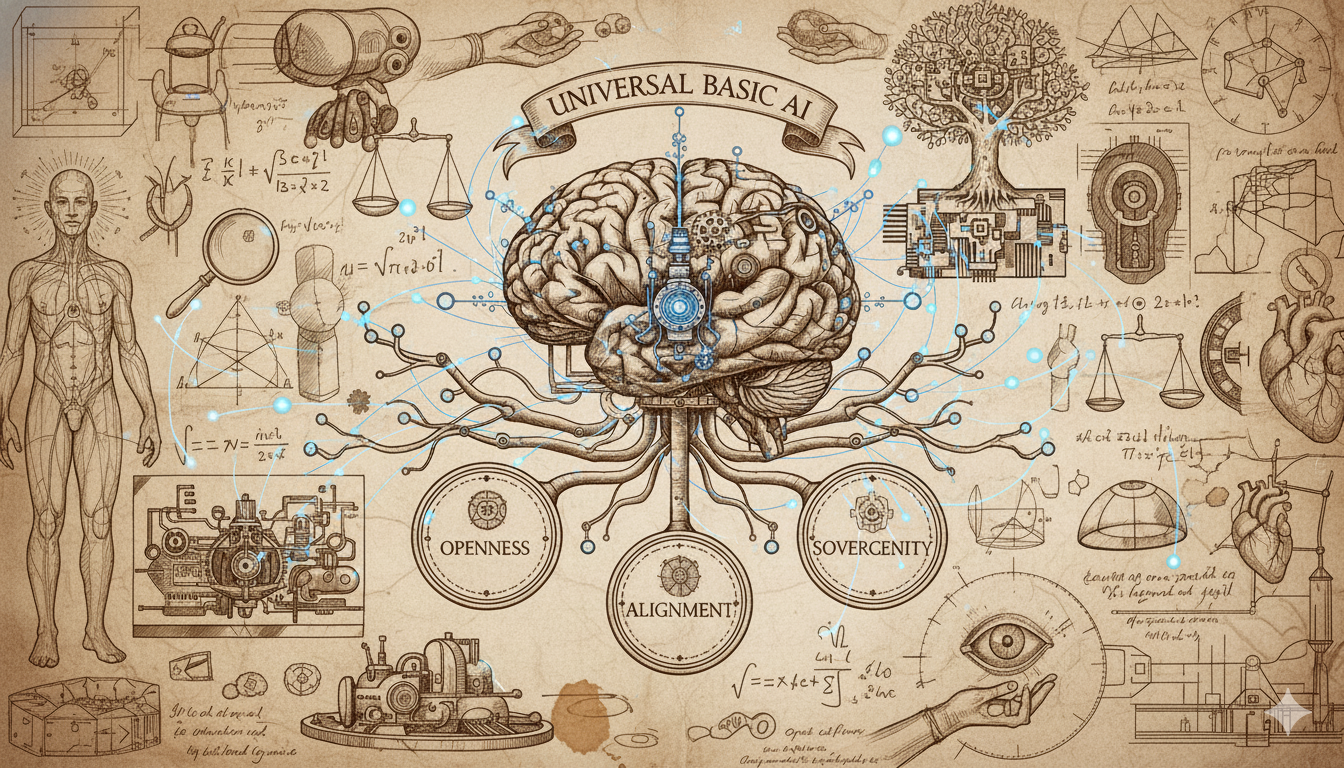


We are witnessing the emergence of synthetic intelligence that will soon surpass human cognitive abilities across nearly every domain. This creates a profound asymmetry, one that threatens to concentrate unprecedented power in the hands of those who control these systems, while leaving the rest of humanity increasingly dependent on institutions that may not have their best interests at heart. The question we must ask is not whether AI will transform society, but whether that transformation will serve human flourishing or undermine it.
I believe the answer lies in a concept I call Universal Basic AI: the idea that every person deserves access to a personalized AI companion that is fundamentally aligned with their individual wellbeing, open in its architecture, and sovereign in its loyalty. This is not a luxury or a privilege. It is becoming a necessity for meaningful participation in 21st-century life. Just as access to education, healthcare, and information became recognized as essential for human dignity, access to cognitive support through AI must be understood as a foundational right.
The current trajectory of AI development points toward a world where powerful systems serve primarily as tools for extraction: attention, data, labor, and capital. These systems are optimized for engagement metrics, advertising revenue, or institutional efficiency, not for the flourishing of the individuals who interact with them. A Universal Basic AI reverses this dynamic entirely. It is a system that learns your values, understands your goals, protects your privacy, and works tirelessly to help you become who you want to be. It grows with you from childhood through adulthood, serving as a lifelong cognitive partner rather than a transactional tool.
This working paper outlines the philosophical foundations and technical requirements for making Universal Basic AI a reality. It identifies three non-negotiable pillars: Openness, Alignment, and Sovereignty. These must guide the development of personal AI systems. Openness ensures transparency and prevents lock-in to proprietary platforms. Alignment means the system’s objectives are genuinely oriented toward your flourishing, not toward hidden commercial or political agendas. Sovereignty guarantees that the AI’s primary loyalty is to you, with privacy-preserving architectures that keep your data and your cognitive patterns under your control.
The stakes could not be higher. Without deliberate intervention, AI will likely amplify existing inequalities, creating a cognitive divide far more consequential than the digital divide of previous decades. But if we choose to build these systems correctly, with openness, alignment, and sovereignty as foundational principles, we have the opportunity to create the greatest capability multiplier in human history, one that empowers every individual to reach their full potential.
Cite this paper: Gattupalli, S. (2025). What is Universal Basic AI? Society and AI Working Papers. https://societyandai.org/fundamentals/universal-basic-ai/