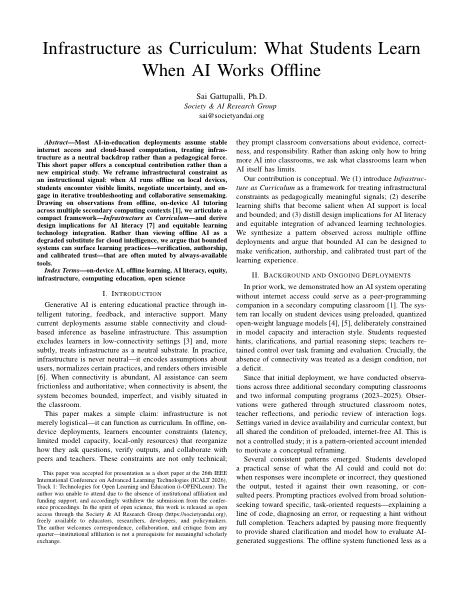
When AI runs offline, its limits stop being a bug and start doing pedagogical work — and the classroom learns something it could not learn from a frictionless cloud.
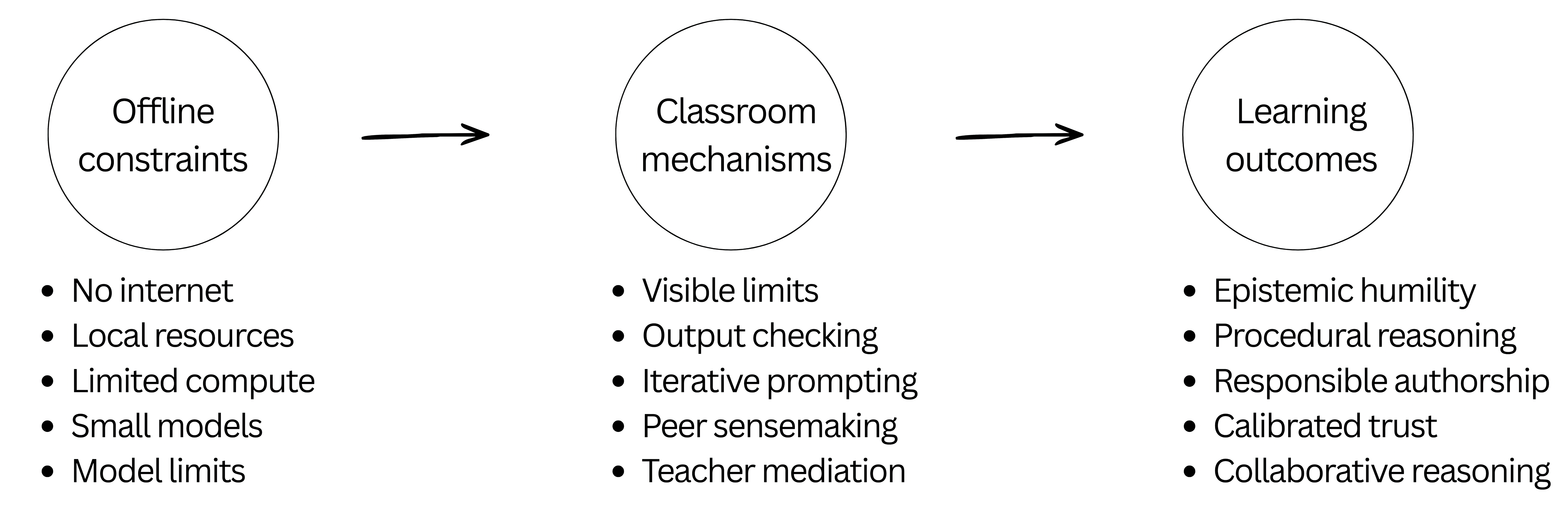
This paper argues that when AI runs offline on local devices in classrooms, the infrastructural constraints themselves become pedagogically meaningful. Drawing on observations from offline, on-device AI tutoring across secondary computing classrooms (2023–2025), it introduces a compact framework — Infrastructure as Curriculum — and derives implications for AI literacy and equitable learning technology design. Rather than viewing offline AI as a degraded substitute for cloud intelligence, the paper argues that bounded systems surface learning practices — verification, authorship, and calibrated trust — that are often muted by always-available tools.
Abstract
Most AI-in-education deployments assume stable internet access and cloud-based computation, treating infrastructure as a neutral backdrop rather than a pedagogical force. This short paper offers a conceptual contribution rather than a new empirical study. We reframe infrastructural constraint as an instructional signal: when AI runs offline on local devices, students encounter visible limits, negotiate uncertainty, and engage in iterative troubleshooting and collaborative sensemaking. Drawing on observations from offline, on-device AI tutoring across multiple secondary computing contexts, we articulate a compact framework — Infrastructure as Curriculum — and derive design implications for AI literacy and equitable learning technology integration. Rather than viewing offline AI as a degraded substitute for cloud intelligence, we argue that bounded systems can surface learning practices — verification, authorship, and calibrated trust — that are often muted by always-available tools.
Open Access Notice
This paper was accepted as a short paper at the 26th IEEE International Conference on Advanced Learning Technologies (ICALT 2026), Track 1: Technologies for Open Learning and Education (i-OPENLearn). Due to the absence of institutional affiliation and funding support, the author was unable to register or attend, and accordingly withdrew the submission from the conference proceedings.
In the spirit of open science, the work is released here as open access — freely available to educators, researchers, developers, and policymakers — with the hope that it will be read, critiqued, adapted, and built upon. Institutional affiliation is not a prerequisite for meaningful scholarly exchange.
A Note from the Author
I am releasing this paper openly because I believe the ideas in it belong to the community of educators and researchers thinking seriously about AI in classrooms — not to a paywall or a conference badge I could not afford. Many PhD graduates, including those from well-resourced R1 institutions, run into the same wall after defense: without an institutional line item, even an accepted paper can quietly become an unpublished one. This release is one small attempt to demonstrate that scholarly contribution does not require institutional backing.
The argument itself is modest. When AI works offline, its limits become visible — and visible limits ask something of learners that frictionless cloud systems do not. Students start to verify, to author, to trust calibratedly. Infrastructure, in that sense, becomes part of the curriculum. The paper sketches a framework for taking that pattern seriously, and offers a few design principles for educators and developers building bounded AI for real classrooms.
If you find any of this useful, or wrong, I would genuinely like to hear from you. Adapt it, critique it, cite it, teach with it, build on it — the work is intentionally open so it can move. Correspondence is welcome at sai@societyandai.org.