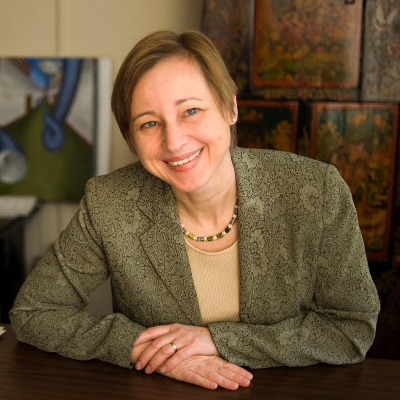
Professor Margrit Betke
Distinguished Fellow, Society & AI
Expertise
Professor Margrit Betke was a pioneering computer scientist, visionary researcher, and beloved mentor whose life’s work exemplified the transformative potential of artificial intelligence when guided by humanistic values and unwavering commitment to societal benefit. Her passing represents an immeasurable loss to the computing research community, yet her intellectual legacy and moral example continue to illuminate pathways toward technology that serves human flourishing.
Pioneering Scholarship in Computer Vision and AI for Good
Betke’s scholarly contributions spanned the breadth of computer vision and artificial intelligence, yet her work remained unified by a singular philosophical commitment: technology must serve people, particularly those most vulnerable. Her research transcended conventional disciplinary boundaries, addressing fundamental challenges in cybersecurity, neuroscience, medical imaging, social media analysis, physical therapy, healthcare, and ecological conservation—each domain approached with rigor, creativity, and profound attention to real-world impact.
Her development of Camera Mouse—an assistive human-computer interface enabling individuals with severe motion impairments to communicate through head-tracking technology—transformed countless lives. Children and adults living with cerebral palsy, spinal muscular atrophy, ALS, multiple sclerosis, and traumatic brain injury gained unprecedented autonomy through this innovation. Betke’s approach to assistive technology development included deliberate community engagement, bringing Girl Scouts and middle school students into the research process, democratizing technological innovation while ensuring its relevance to lived experience.
This pattern of community-centered research characterized her entire career. She developed machine learning models predicting stroke recovery, created video-based ecological censusing systems for conservation biology, designed AI systems evaluating physical therapy rehabilitation exercises, and pioneered medical imaging algorithms for early cancer detection. Each contribution reflected her capacity to bridge technical excellence with deep understanding of domain-specific challenges, working collaboratively with clinicians, educators, ecologists, and community members.
Intellectual Leadership and Institutional Vision
Beyond individual research achievements, Betke demonstrated exceptional institutional leadership, shaping the infrastructure through which future generations would advance AI research. She served as the driving force behind Boston University’s Computer Science MS in AI program, which she directed, and championed the development of the PhD program in Computing & Data Sciences. As co-director of the Artificial Intelligence Research (AIR) Initiative at the Rafik B. Hariri Institute for Computing and Computational Science & Engineering, she cultivated interdisciplinary collaboration a full decade before “convergence research” entered common academic discourse.
Colleagues recognized her as “an early advocate for interdisciplinary collaboration,” whose work anticipated the AI for Good movement. She co-founded and co-led the Computer Science Image and Video Computing Research Group, authored more than 200 research papers, secured major research grants including the prestigious National Science Foundation Faculty Early Career Development Award (2001), and served in leadership roles for premier journals and conferences. Her scholarship addressed critical questions of bias, equity, and ethics in AI systems, exploring how artificial intelligence might be made more inclusive across diverse settings and populations.
Her co-leadership of the AI and Education Initiative at the Hariri Institute demonstrated prescient understanding of artificial intelligence’s potential role in learning contexts—work that included pioneering studies using facial expression analysis to predict student mathematics learning outcomes. This research domain, though still emergent at the time of her passing, exemplifies her capacity to identify consequential questions before they achieved widespread recognition.
A Legacy of Mentorship and Moral Exemplarity
Perhaps Betke’s most enduring contribution lies not in any single algorithm or system, but in the 20 doctoral students she guided, the countless undergraduate and graduate researchers she mentored, and the generations of scholars she inspired through her example. Former students speak of her with reverence bordering on devotion: “You were my children,” she told them in her final days—words that captured the depth of her commitment to their intellectual and personal development.
“There are many people that are where they are, or who they are, today because of the way she touched their lives and set them on the path that they ended up walking,” reflects one former student. Others describe her as “a motherly, nurturing, loving mentor who cared deeply about her students,” someone who “fostered an environment of intellectual freedom” while providing guidance when students faltered. Even in her final weeks, she continued reading proposals, mentoring students, submitting patents and papers, and editing work with former students—including a Best Paper Award at the Annual Meeting of the Association for Computational Linguistics for research on climate change narratives.
Her dedication extended beyond research supervision to encompass students’ full human development. She was known for spending entire nights on Zoom calls helping students perfect papers, for her exacting standards paired with profound compassion, and for serving as “a moral compass” guiding students’ research choices and life paths. “She is my moral compass in the kind of research work I would like to do and how I want to live my life,” one former student testified. “I will forever remember all her scoldings, guidance, and appreciation.”
Enduring Relevance in an Era of Transformative AI
Professor Betke’s death preceded full realization of her vision for artificial intelligence as a force for societal transformation. Yet the principles animating her work—cross-disciplinary collaboration, community engagement, attention to equity and inclusion, focus on assistive and empowering applications—have acquired heightened salience as AI systems achieve unprecedented capabilities and influence.
Her insistence that “this kind of research matters to people and connects to their lived experiences” offers essential guidance for contemporary AI development. Her example demonstrates that technical excellence and humanistic commitment need not exist in tension; indeed, the most consequential innovations emerge from their synthesis. Her work on assistive technologies, medical imaging, ecological conservation, and educational AI established proof of concept for technology designed to uplift rather than merely optimize.
Society & AI honors Professor Margrit Betke’s memory by embracing the values she embodied: intellectual rigor coupled with moral purpose, technical innovation guided by human need, research excellence integrated with mentorship devotion, and unwavering belief in artificial intelligence’s potential to advance human flourishing when developed with wisdom, equity, and care.
“It was a good life,” she told those gathered in her final days. Her life’s work—the students mentored, the technologies created, the scholarly foundations laid, the institutional infrastructure built, the collaborative networks fostered, and the moral example set—ensures that her influence will continue shaping how we understand artificial intelligence’s role in creating a more just, accessible, and humane world. Though her voice has been silenced, her vision endures, calling us toward technology that truly serves humanity’s highest aspirations.
Professional Appointments
Professor of Computer Science, Boston University
Education
PhD in Computer Science and Electrical Engineering, Massachusetts Institute of Technology